imported post
imported post
ZED wrote:
Internet forumns are definitely full of opinions, and us KLR folk tend to gravitate to any mod that's
A. Cheap (like, a few dollars per mod sor of realm),
B. Easy (can be done at a tech day with friends and beer :hb

,
AND
C. Has the slightest chance of improving the performnace of our favorite heavy pig!
I haven't done the PCV mod on mine. There are two '05s in our house that have been well flogged. Perhaps someone can explain what the intended purpose of this mod is. Is it just for preventing oil loss due to blow-by and increased crank-case pressures? If so, I don't think I'd worry about it until it oil consumption becomes a problem. Even at about 50k on one of our KLRs, it still doesn't really consume oil.
Here's the idea (copied from the above linked thread):
==========================================================
Ya see, Some years ago, those of us into racing, tried experimenting with one way valves or check valves to evacuate the pressure created in the crankcase of an engine as a piston reaches the bottom of it's stroke. The thought was, that if you could get the air out from under the piston as it came down, then the piston wouldn't have to compress it, and there would be more power for the rear wheel. Long story short, it wont work on a two stroke, 'cause they use that pressure to charge the cylinder, and most fourstroke racing engines are of a multi cylinder design, and so as one piston comes down, another is going up, which kinda balances out the pressure anyway. So the idea was largely abandoned as more work than it was worth.
Enter the KLR. Four stroke.
One cylinder. Piston goes down, pressure builds up beneath it, no other piston to move up at that moment to equalize things.
So... ya get an old fashioned
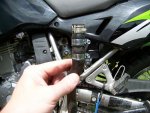
PCV valve from ( in my case ) an old Chevy, and install it in the vent, so that air pushed out of the vent, as the piston goes down, can't get back in when the piston goes back up. And just for kicks, ya vent it overboard ( at least that's what I did )
The bike seems a little more peppy. But that's not proven in any way that I'd even think about publishing. But something else interesting has happened instead. Cary said yesterday that his oil consumption has gone down by at least 20%-25%. So, I checked mine, and saw that this last trip, I've not used any. Now the thing about that is, I run a 14 tooth CS sprocket, and on the highway I run 5000 rpm. I hate it, but I'm too lazy to change the sprocket twice a week. (A 16 for commuting and a 14 for off-road work on the weekends). Last week, prior to the check valve installation, I used about 100cc of oil in about 300 miles ( my weekly commute ) And, As I said, I haven't used any this week. If I haven't put in a quart a month, or every thousand miles, I think this will be worth the 5 smackers I paid for it.
It seems that in addition to letting out the pressure, and not letting it back in, the valve creates a vacuum on the underside of the piston, such that as the piston travels down on the intake stroke, the low pressure on top of the piston, that allows fuel and air to be sucked in, is somewhat countered, by the low pressure below the piston created by the check valve, and the tendency of the oil to be sucked past the rings into the cylinder, is reduced...a lot. In addition to that, the blowby on the compression stroke, that would also be vented into the airbox, as unburnable carbon monoxide and oil vapor, now goes overboard, and is replaced in the carb, by fresh air...much more combustible. Now Cary says this isn't as significant as I thought and that the suction from the airbox is more important to the crankcase than it is to not put the blowby into the carb.
Now, there's no way I'm gonna leave the vent open to water crossings, but I am gonna see if there's a way to vent it overboard to the atmosphere, without putting it into my engine. I think one of those little rubber vents that has a slit in it, like they use on the battery vent of some bikes may be the ticket, as well as acting as a secondary check valve, kinda like a reed valve.
Like I said it was KLRCary's idea in the first place, so I'm not gonna say anything more on the forums, but any experiment, is more accurate if you have more data, or ideas, to draw on.
Now Cary has a setup that has some elbows to help condense the oil vapor, and his vents back into the airbox to use that suction to aid the evacuation of the crankcase, but here's what mine looks like.
============================================================
I was discussing this idea with a friend the other day, and he made an intersting point - He feels that increased lubrication to the top of the rings at high RPMs outweighs the inconvenience of having to top off the oil after high speed running. IE as long as the engine is otherwise healthy, consuming oil at high speed is not such a bad thing - in fact many engines are designed this way.
Food for thought. It's an interesting issue.
Matthew